
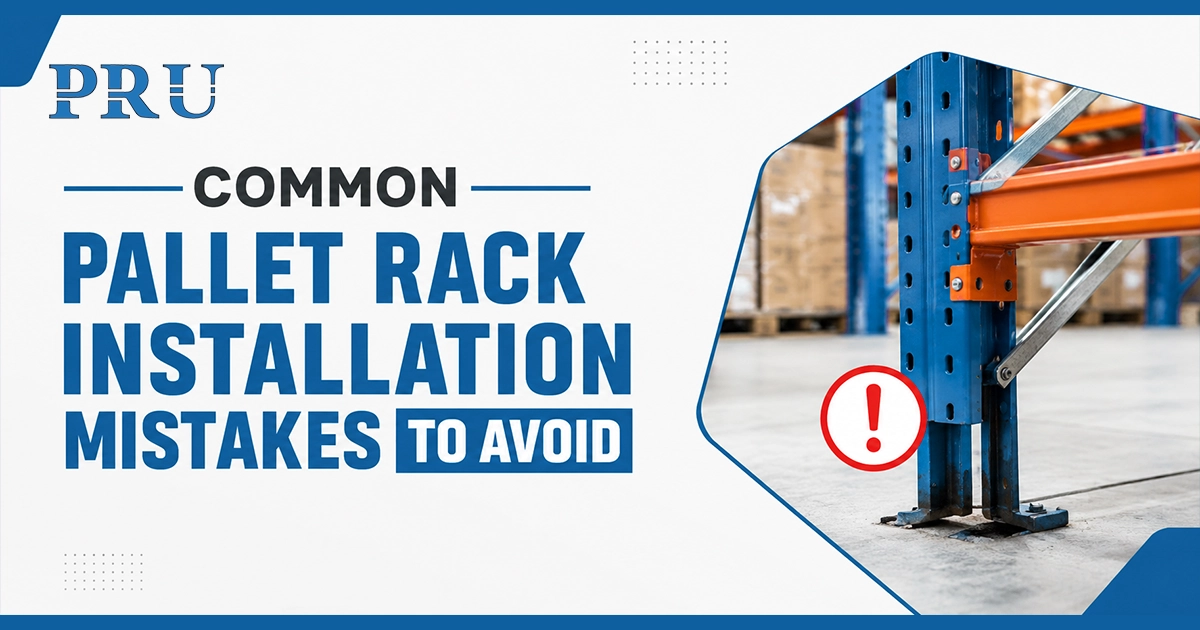
Common Pallet Rack Installation Mistakes to Avoid
Common Pallet Rack Installation Mistakes to Avoid
Walk into almost any warehouse that’s had a rack collapse, and you’ll hear some version of the same story: “We didn’t think it was a big deal at the time.” A missing bolt here, a rack anchored to an uneven floor there, a load limit nobody bothered to check. None of it looked dangerous at the moment. Then a few thousand pounds of inventory came down.
Pallet racking failures rarely happen because of one dramatic error. They happen because of small, avoidable mistakes made during installation , mistakes that sit quietly for months until the wrong combination of weight, vibration, or a forklift bump exposes them. If you’re planning to install pallet racks in your facility, or you’ve inherited a system someone else put in, it’s worth understanding exactly where things tend to go wrong, and what OSHA-approved safety practices actually require.
Why Installation Mistakes Are More Common Than You’d Think
Pallet racks look simple. Uprights, beams, a few connector pins, maybe some bracing. That apparent simplicity is exactly why so many installations go wrong , teams treat it like assembling shelving rather than erecting a structural system that will hold tons of moving inventory a few feet from where employees walk and drive forklifts every day.
Most facilities either handle installation in-house with general labor or bring in a contractor who’s never seen the manufacturer’s load specs for that specific rack line. Either way, the same handful of mistakes shows up again and again.
The Most Common Pallet Rack Installation Mistakes
Skipping the Floor Assessment
Racking systems depend on a level, structurally sound floor. Installers often anchor uprights into concrete without checking for slab thickness, cracks, or slope. An uneven floor throws off the entire rack’s plumb and puts uneven stress on the base plates , a problem that only gets worse as loads go on.
Under-Anchoring or Skipping Anchors Entirely
This is the single most cited violation in warehouse safety audits. Anchors aren’t optional or “temporary until we get around to it.” Every upright base plate needs the correct number, size, and embedment depth of anchors specified by the manufacturer and the local building code , not a rough guess based on what looks sturdy.
Ignoring Load Capacity Ratings
Every rack has a rated capacity per beam level and per bay, clearly marked on a load plaque. Warehouses routinely overload racks because nobody trained staff to read that plaque, or because inventory changed over time without anyone reassessing the load. Exceeding rated capacity is one of the fastest ways to cause structural failure.
Improper Beam-to-Upright Connections
Beams that aren’t fully seated and locked into the upright connectors can shift or disengage under load, especially with repeated forklift impact. This is a fast, cheap fix during installation , and an expensive, sometimes catastrophic problem once the rack is loaded and in service.
No Row Spacer or Bracing Where Required
Rows of back-to-back racking need row spacers, and single rows often need diagonal or horizontal bracing for stability. Skipping this step to save time or material is a common shortcut that undermines the rack’s resistance to lateral forces.
Inadequate Aisle Clearance and Guarding
Racks installed too close to forklift aisles, without corner guards or column protectors, invite impact damage. A single unprotected upright hit hard enough can compromise the integrity of an entire bay.
No Post-Installation Inspection
Even a technically correct installation needs a final walkthrough , checking plumb, level, anchor torque, and beam locks , before the rack goes into service. Many facilities skip this because the installer has already moved on to the next job.

OSHA-Approved Safety Practices for Pallet Rack Installation
OSHA doesn’t publish a single stand-alone “pallet rack” standard, but rack installations fall under general industry requirements (primarily 29 CFR 1910), and OSHA regularly cites facilities for violations tied to unsafe racking under walking-working surfaces, materials handling, and general duty clause provisions. In practice, following OSHA-aligned safety practices means:
- Following the manufacturer’s engineering specs exactly , anchor type, spacing, torque, and beam connections should never be improvised.
- Displaying load capacity plaques on every rack section, visible to anyone loading it.
- Training employees who operate forklifts near racking or load pallets on capacity limits and safe loading height.
- Inspecting racks regularly for damage, bent frames, missing pins, or loosened anchors , and repairing or red-tagging damaged sections immediately.
- Maintaining clear aisle widths appropriate for the equipment used in the facility.
- Keeping installation records , including manufacturer drawings, anchor specs, and inspection sign-offs , in case of an audit or incident review.
These aren’t bureaucratic checkboxes. Every one of them maps directly to a real failure mode seen in warehouse accident reports.
How to Avoid These Mistakes From the Start
The most reliable way to sidestep all of the above is to treat rack installation as a structural project, not a shelving project. That means:
- Getting a floor assessment before anchoring anything.
- Using the manufacturer’s load charts and installation manual , not a generic template from a different rack brand.
- Bringing in installers who specifically understand safe pallet racking, not general handymen.
- Scheduling a third-party inspection after installation, especially for high-bay or heavy-duty systems.
- Documenting everything, so future audits or OSHA inspections have a clear paper trail.
If your team doesn’t have this expertise in-house, it’s worth looking into pallet rack installation services that specialize in warehouse racking specifically. A specialized crew will already be fluent in OSHA safety guidelines, manufacturer torque specs, and load plaque requirements , the details that get skipped when installation is treated as a side task for whoever’s available that week.
Final Thoughts
Most rack collapses are preventable. They come from a chain of small decisions , a skipped anchor, an unchecked load rating, a beam that wasn’t fully seated , that seemed harmless individually but added up to a serious hazard. Getting installation right the first time, following pallet rack safety guidelines closely, and inspecting the system regularly afterward is far cheaper than dealing with the aftermath of a collapse: damaged inventory, downtime, OSHA fines, or worse, an injured employee.
If you’re planning a new layout or auditing an existing one, start with the basics: level floors, proper anchors, correct load ratings, and OSHA-approved safety practices at every stage. It’s not glamorous work, but it’s the difference between a warehouse that runs safely for decades and one that ends up in an incident report.
Need a hand getting it right? Pallet Rack Unlimited specializes in safe pallet racking installations built to OSHA safety guidelines and manufacturer spec, get in touch to have your layout reviewed before (or after) you load it.
Leave a Reply