
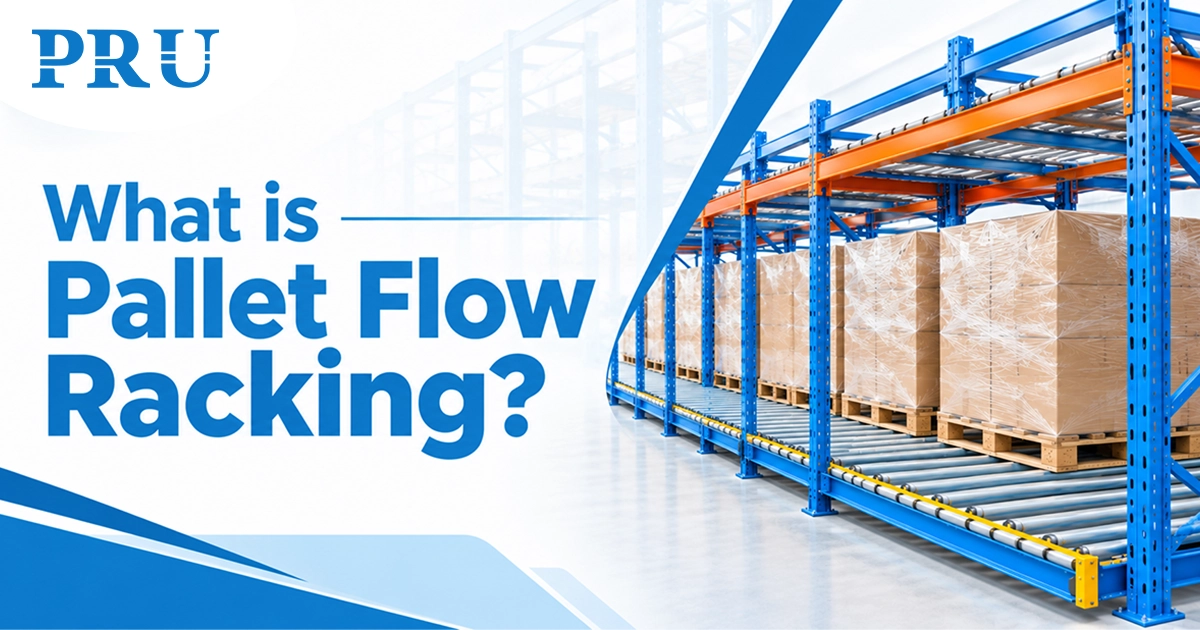
What is Pallet Flow Racking?
Pallet flow racking is a high density storage system that uses slightly inclined roller lanes so pallets move by gravity from the loading side to the picking side. It enforces first in, first out rotation automatically, which makes it popular for perishable and date sensitive goods. The tradeoffs are a higher upfront cost, a need for good quality pallets, and more maintenance than simpler racks.
Key takeaways
- Pallets are loaded at the high end of an inclined lane and flow forward by gravity as pallets are removed.
- Speed controllers act as brakes so pallets move at a safe, steady pace.
- The system stores pallets deep, which saves floor space by removing most aisles.
- It delivers true first in, first out rotation without extra handling.
- It costs more than selective racking, works best with consistent pallets, and dedicates each lane to a single product.
If your warehouse handles perishable goods, or anything that must leave in the order it arrived, you have probably heard someone mention pallet flow. It is one of the few racking systems that solves stock rotation by design instead of by discipline.
It is also one of the most specialized. This guide explains what pallet flow racking is, how it works, where it shines, and where another system will serve you better.
What Is Pallet Flow Racking?
Pallet flow racking, also called gravity flow racking or pallet live racking, is a dynamic storage system. Instead of pallets sitting still in a fixed position, they travel. Each lane is built from roller tracks or wheel tracks set at a slight incline, so a pallet placed at the high end rolls down toward the low end on its own.
The result is a lane that holds several pallets of the same product, with the oldest one always waiting at the front. When someone removes that pallet, the next one moves up to take its place.
How Pallet Flow Racking Works
A pallet flow system has a few core parts working together:
- The rack structure. A standard pallet rack frame supports the lanes.
- Inclined flow rails. Rollers or wheels set on a gentle slope carry pallets from the loading side to the picking side.
- Speed controllers. These brakes regulate how fast pallets travel, so loads do not accelerate and slam into each other. They are placed at intervals along the lane.
- Entry guides and stops. These help forklift operators place a pallet squarely in the lane and stop pallets safely at the pick face.
The workflow is simple. A forklift loads pallets into the rear of the lane from one aisle. Gravity moves them forward. Another operator picks from the front of the lane in a separate aisle. Because loading and picking happen on opposite sides, the two activities stay out of each other’s way.
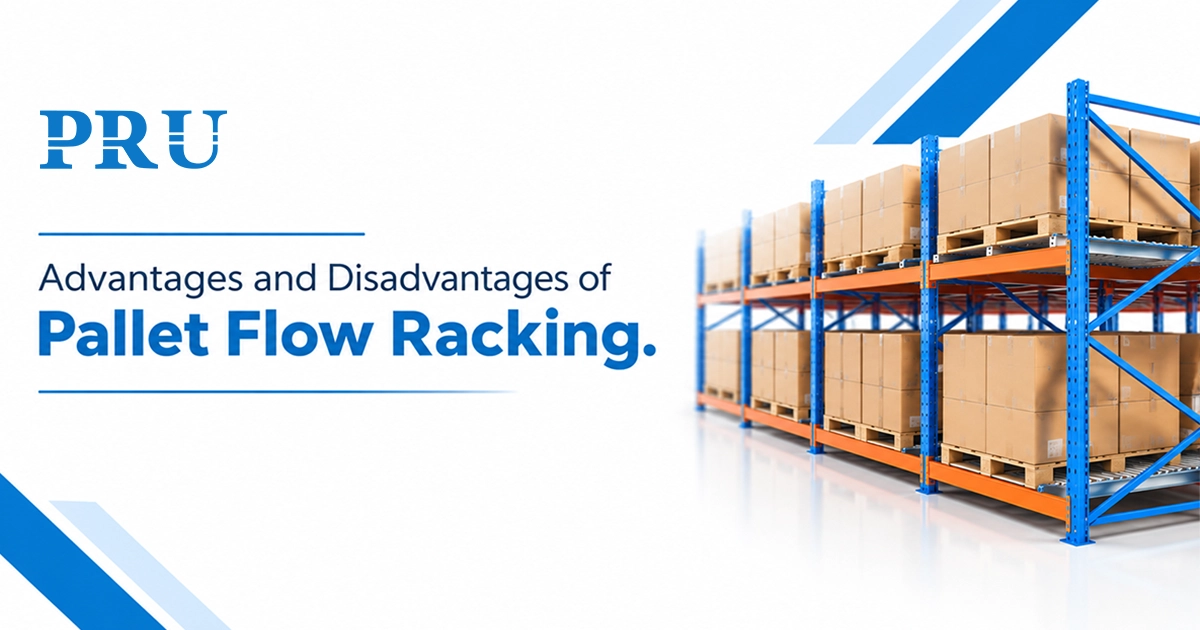
Advantages of Pallet Flow Racking
Automatic first in, first out rotation. The oldest pallet is always at the front, so stock rotates in order with no extra handling. For food, beverage, pharmaceuticals, and other date sensitive products, that is often the deciding factor.
High storage density. Lanes can hold multiple pallets deep, commonly anywhere from a few pallets to twenty or more depending on the design. Since you need fewer aisles than a selective system, you store more in the same footprint.
Faster, safer picking. Product is always presented at the front of the lane, so operators do not need to drive into the rack or shuffle pallets to reach what they need.
Separate loading and picking aisles. Putting replenishment on one side and picking on the other reduces forklift congestion and the chance of collisions.
Less handling means less damage. Pallets are placed once and retrieved once. Speed controllers keep movement smooth, which helps protect product and the rack itself.
Scalable lane depth. Lane lengths can be designed around how much of each SKU you typically hold.
Disadvantages of Pallet Flow Racking
Higher upfront cost. Rollers, brakes, and precise engineering make pallet flow one of the more expensive rack types. Published industry pricing guides place it at roughly $135 to $400 per pallet position, depending on lane depth and specification. These are planning figures, not quotes.
It depends on pallet quality. Pallets need to be in good, consistent condition to travel smoothly. Broken boards, protruding nails, or mixed pallet types can cause jams and add replacement costs.
One product per lane. Because each lane holds a single SKU, pallet flow is a poor fit for operations with many products stocked in small quantities. Selectivity is limited compared with standard racking.
More maintenance. Rollers, wheels, and brakes are moving parts. They need regular inspection to keep lanes running smoothly.
Deep lane pressure. In longer lanes, the weight of pallets behind can make it harder to pull the front pallet out. Pallet separators are often used to isolate the front pallet and relieve that pressure.
More complex planning. The slope, lane length, load weight, and brake placement all have to be engineered correctly, so it is not a system to improvise.
Pallet Flow vs Other Rack Types
| Features | Pallet Flow | Selective | Push Back | Drive In |
|---|---|---|---|---|
| Stock Rotation | First In, First Out (FIFO) | Any Pallet, Any Time | Last In, First Out (LIFO) | Last In, First Out (LIFO) |
| Storage Density | Very High | Lower | High | High |
| Access to Each Pallet | Front of Lane Only | Every Pallet | Front of Lane Only | Limited |
| SKU Variety | Best for Fewer SKUs | Best for Many SKUs | Moderate | Fewer SKUs |
| Relative Cost | Higher | Lower | Moderate to Higher | Moderate |
| Moving Parts | Yes | No | Yes | No |
Who Should Consider Pallet Flow Racking?
Pallet flow tends to be a strong fit when:
- You store perishable, date coded, or time sensitive products
- You move high volumes of the same SKUs
- Strict stock rotation is a requirement, not a preference
- You want to save floor space, such as in cold storage where space is expensive
- You use consistent, good quality pallets
It is usually the wrong fit when you stock many different SKUs in small quantities, when rotation does not matter, or when your pallets vary widely in condition and size. In those cases, a selective system, or a push back or drive in system, may serve you better.
Planning Checklist
- List your SKUs and volumes. Pallet flow rewards high volume, low variety inventory.
- Confirm rotation needs. If first in, first out is a must, pallet flow moves to the top of the list.
- Check pallet condition. Decide whether you can standardize on a consistent pallet.
- Measure your space. You need room for both a loading aisle and a picking aisle.
- Define lane depth. Match it to how many pallets of each SKU you typically hold.
- Plan maintenance. Assign inspection of rollers, brakes, and stops to someone.
- Get a design review. Slope, brake placement, and load weight should be engineered, not guessed.
Safety and Maintenance
Pallet flow racks follow the same industry framework as other rack types, including ANSI MH16.1, which covers design, load capacity, and use. In practice, that means displaying the rated load, anchoring the structure, and inspecting for damage. For pallet flow specifically, regular checks of rollers, brakes, guide rails, and stops in heavily used lanes help prevent jams and uneven movement. Enforcing consistent pallet quality and proper load wrapping also reduces problems before they start.
Frequently Asked Questions
What is pallet flow racking used for?
Pallet flow racking is used where stock must be rotated in the order it arrives, such as food and beverage, cold storage, pharmaceuticals, and high volume distribution. It stores pallets deep while keeping the oldest one at the pick face.
How does pallet flow racking work?
Pallets are loaded at the high end of an inclined roller lane and move forward by gravity toward the picking end. Speed controllers regulate how fast they travel, and stops hold the front pallet at the pick face until it is removed.
What are the main advantages of pallet flow racking?
The main advantages are automatic first in, first out rotation, high storage density, faster picking, separate loading and picking aisles, and less handling damage. These benefits are strongest for high volume, low variety inventory.
What are the main disadvantages of pallet flow racking?
The main disadvantages are higher upfront cost, a dependence on good quality pallets, one product per lane, and more maintenance because of moving parts. Deep lanes can also need pallet separators to make front pallet removal easier.
Is pallet flow racking first in, first out or last in, first out?
Pallet flow racking is first in, first out. Pallets are loaded at the back and removed from the front, so the oldest stock is always picked first. Push back and drive in racking work on a last in, first out basis.
Is pallet flow racking worth the cost?
It often is when strict rotation or dense storage is essential, since it can save floor space and reduce handling. If rotation does not matter or you carry many SKUs in small quantities, a less expensive rack type may be a better value.
Final Thoughts
Pallet flow racking is a specialist tool. When rotation matters and volume is high, it can pay for itself in saved space, faster picking, and fewer product losses. When your inventory is varied or your pallets are inconsistent, it adds cost and complexity you may not need.
The right choice starts with how your product actually moves. Pallet Rack Unlimited’s design specialists can review your SKUs, volumes, and layout and tell you honestly whether pallet flow fits or another system serves you better. You can also browse our pallet rack options, look into financing for larger projects, and have our installation team handle setup.
Call us at 770-714-9911 or get a quote.
Leave a Reply